
Are Reed Diffusers Safe for Cats? An Honest Guide for Cat Owners
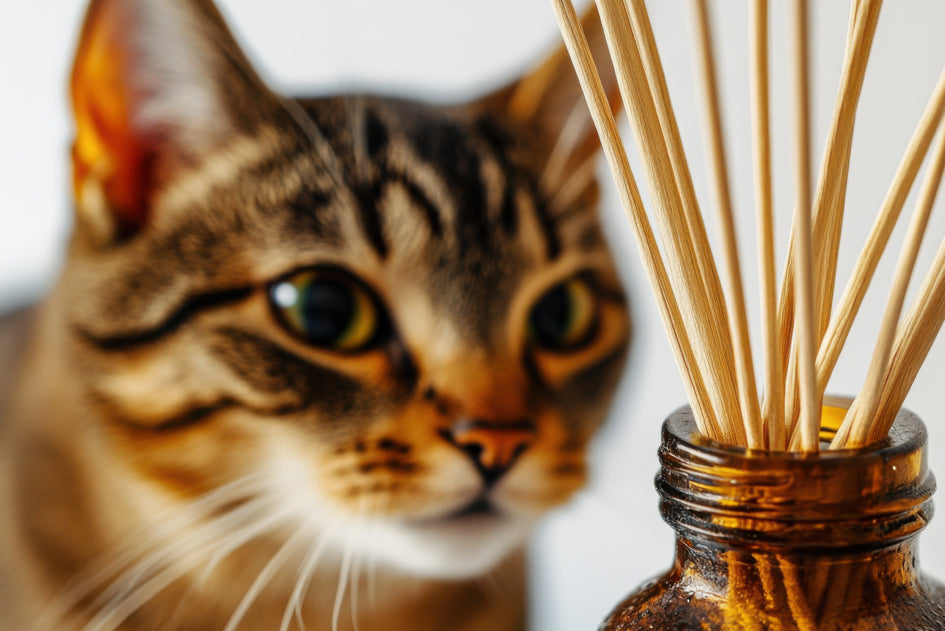
The short answer: used correctly, yes — reed diffusers are safe to use in a home with cats. The fragrance drifting off the reeds at normal room levels is very unlikely to harm a healthy cat. The genuine risk is your cat getting at the liquid — drinking it, chewing the reeds, or knocking the bottle over and grooming it off their fur. For a cat, that last one matters more than you'd think, and we'll explain why.
We have pets in abundance here at Fosse Living, so this is written from a house full of fur as much as a fragrance workshop. Here's the complete, honest picture.
Why cats get their own article
We've written separately about reed diffusers and dogs, and cats deserve more than a copy-and-paste of that advice, for two biological reasons.
Cats process certain compounds differently. Cats' livers are missing some of the enzymes that humans and dogs use to break down particular substances — including phenols and related compounds found in some essential oils. It's the same reason some perfectly good dog medicines are dangerous for cats. The concentrated oils with the worst reputations — tea tree, eucalyptus, wintergreen, pennyroyal, some citrus and pine oils — are a bigger concern for cats than for any other pet in the house.
Cats groom. Anything that ends up on a cat's fur — a splash from a toppled diffuser, liquid off a chewed reed — is in their mouth within the hour. For a cat, "on the fur" and "swallowed" are effectively the same event. A spill that a dog would walk away from becomes an ingestion for a cat.
And one behavioural reason: "keep it up high" doesn't work. That's the cornerstone of our dog advice, and it's nearly useless for an animal that treats the mantelpiece as a footpath. Cat-proof placement is a different skill, and we'll come to it.
The honest disclaimer we give everyone
UK home fragrance products are made to IFRA safety standards, and those standards are written for humans. The only way to definitively prove a fragrance safe for cats would be animal testing, which we don't support and won't do. So "pet safe" — from us or anyone — means: no ingredients known to be harmful, sensible exposure levels, honest guidance. Any brand claiming more certainty than that is selling confidence nobody has.
Relatedly, you'll see "essential oils dangerous, fragrance oils fine" all over the internet. Half-truth. Fragrance oils often contain the same aroma compounds (limonene, linalool and friends) as the essential oils they mimic. What protects your cat isn't a word on a label — it's low airborne levels, and concentrated liquid never reaching their mouth or fur.
Sniffing vs swallowing
Normal use. A reed diffuser releases fragrance passively and very slowly — no heat, no flame, no mist. The airborne concentration in a normally ventilated home is tiny, and your cat already lives among scent from your cleaning sprays, washing powder and cooking. For a healthy cat, this everyday exposure is very low risk.
Two exceptions deserving extra respect: cats with asthma (feline asthma is real and reasonably common — airborne irritants of any kind can aggravate it, so keep fragrance out of an asthmatic cat's rooms and speak to your vet first), and sealed rooms (never run a diffuser in a small closed room a cat is shut in — an open door is a cat's best safety feature).
The liquid. The bottle contains concentrated fragrance oil in a carrier solvent. Not for drinking, and doubly not for cats. The classic incident isn't a cat deliberately drinking it — it's a bottle batted off a shelf, liquid on paws and flank, and a thorough grooming session doing the rest. Chewed reeds are the junior version: each reed holds only a little liquid, but it's concentrated.
What to do if it goes wrong
If your cat drinks diffuser liquid, chews a reed, or gets liquid on their fur:
- Move the diffuser and any spilt liquid out of reach and estimate how much is missing.
- Fur contact: stop the grooming if you can and wipe off as much as possible with a damp cloth — then get advice before bathing with anything.
- Do not try to make your cat vomit.
- Call your vet, or the Animal PoisonLine on 01202 509000 (24 hours), with the product name to hand — our ingredient and allergen information is on every label and listing.
- Watch for drooling, vomiting, wobbliness, pawing at the mouth, lethargy, or any change in breathing — and treat breathing changes as urgent.
Cats are experts at hiding illness. With a known exposure, make the phone call even if they seem fine.
Cat-proof placement: stable and boring beats high
Forget altitude; think unreachable and unrewarding:
- Choose enclosed, stable spots. The back of a deep bookshelf, inside an alcove, behind a row of books or a picture frame — somewhere a cat can't sit beside it, because a cat who can sit beside it will eventually push it off for science.
- Weight helps. A heavier bottle on a non-slip surface survives an investigative paw far better than a light one on polished wood.
- Rooms, not just surfaces. The most reliable cat-proofing is a door — a diffuser in a room your cat doesn't frequent beats clever shelf engineering every time.
- Leave scent-free territory. Keep your cat's core rooms — bed, food, litter tray — completely unscented. Cats rely on scent for security far more than we do; their space should smell of them.
- Introduce gradually and watch. If your cat leaves the room whenever a particular scent is out, that's a vote worth counting.
Signs a fragrance doesn't agree with your cat
- Sneezing, coughing, wheezing or watery eyes when the diffuser's in the room
- Drooling or pawing at the mouth
- Face-rubbing or over-grooming
- Avoiding rooms they normally use
- Laboured or open-mouthed breathing — in a cat, always a prompt vet matter
Mild signs: move or remove the diffuser and see if things settle. Persistent or breathing-related: vet.
Quick answers
Are reed diffusers toxic to cats if they smell them? At normal room levels, no — passive airborne exposure from a reed diffuser is very low. The toxicity concern is about the concentrated liquid being swallowed, usually via a spill and grooming.
My cat chewed a reed — should I worry? A single reed carries little liquid, so serious harm is unlikely — but it's concentrated, so it's still worth a precautionary call to your vet or the Animal PoisonLine, especially for kittens.
Which scents are worst for cats? The documented offenders are concentrated essential oils — tea tree, eucalyptus, wintergreen, pennyroyal, and some citrus and pine oils. There's no equivalent definitive list for finished diluted products, which is exactly why the practical advice is about preventing ingestion rather than memorising scent lists. If your cat has known sensitivities, check the allergen information on the listing first.
What about ultrasonic essential oil diffusers? A different product with a different risk: they actively mist oil droplets into the air, which can settle on fur and be groomed off — a route of exposure a passive reed diffuser doesn't have. It's one reason we'd choose reeds over mist in a cat household.
Is a reed diffuser safer than a candle for cat owners? In one clear way, yes — no flame and no hot wax for a tail or paw to find. The trade-off is a knockable bottle of liquid, which is why placement is the whole game.
The bottom line
Cats and reed diffusers share millions of homes without incident — including ours. The airborne fragrance is the least of your worries; the bottle is the whole story. Put it somewhere genuinely unreachable rather than merely high, keep your cat's own territory unscented, and treat any spill-and-groom or chewed reed as a phone call to the vet.
All our reed diffusers are made by hand in Warwickshire, with allergen information on every listing: browse the collection. Wax melt fan too? Cats get their own honest guide for those as well: Are Wax Melts Safe for Cats? And for the dogs of the house: Are Reed Diffusers Toxic to Dogs?


Comments